Fatigue & fracture analysis of the de Havilland Comet
Investigated the 1954 de Havilland Comet fuselage failures by comparing stress concentrations across window geometries and simulating cyclic fatigue crack propagation using Abaqus XFEM and the Virtual Crack Closure Technique (VCCT).
Media showcase
Overview
In 1954, the de Havilland Comet experienced catastrophic in-flight breakups due to explosive decompression. The failures were traced to its square windows, which featured stress concentration points at the corners that severely weakened the aluminum fuselage during repeated cabin pressurization. This project mathematically and computationally reconstructed this failure, analyzing how geometric discontinuities amplify local stresses and utilizing finite-element modeling to predict fatigue-crack growth under realistic flight loads.
Key highlights
- Modeled the 0.71 mm thick fuselage skin using DTD 546/Alclad 2024-T4 aluminum alloy properties, applying a far-field tensile stress of 128 MPa to simulate an internal cabin pressure differential of 8.25 psi.
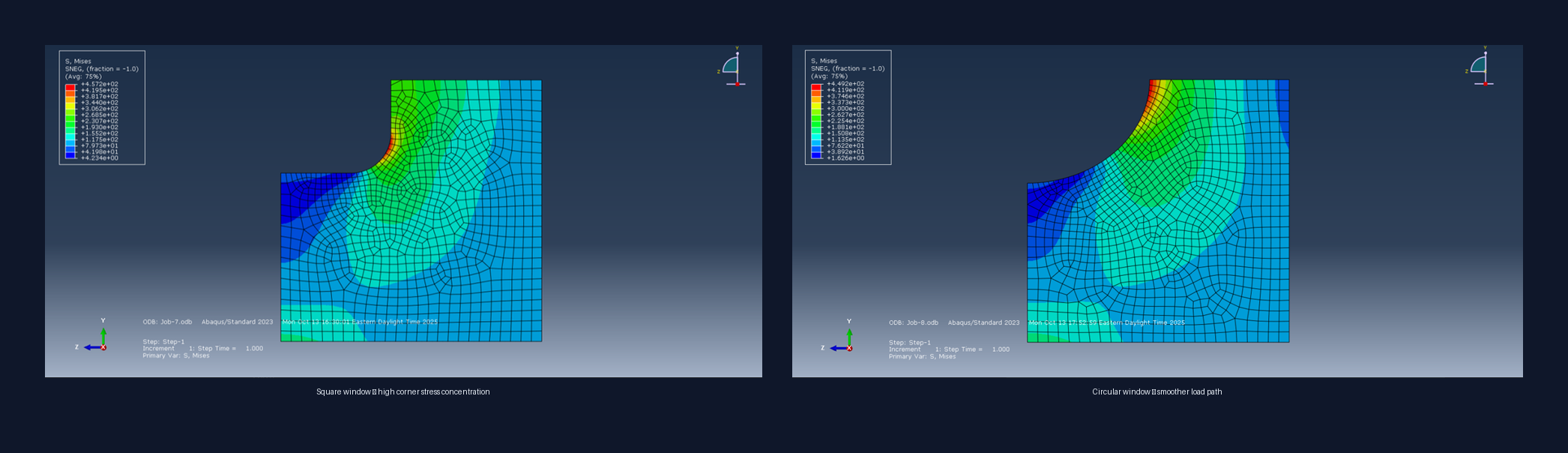
- Compared three window geometries with equivalent opening areas, proving the original square design generated a stress concentration factor (Kt) of roughly 3.34 and peak stresses of ~457 MPa, compared to just ~337 MPa for the circular design.
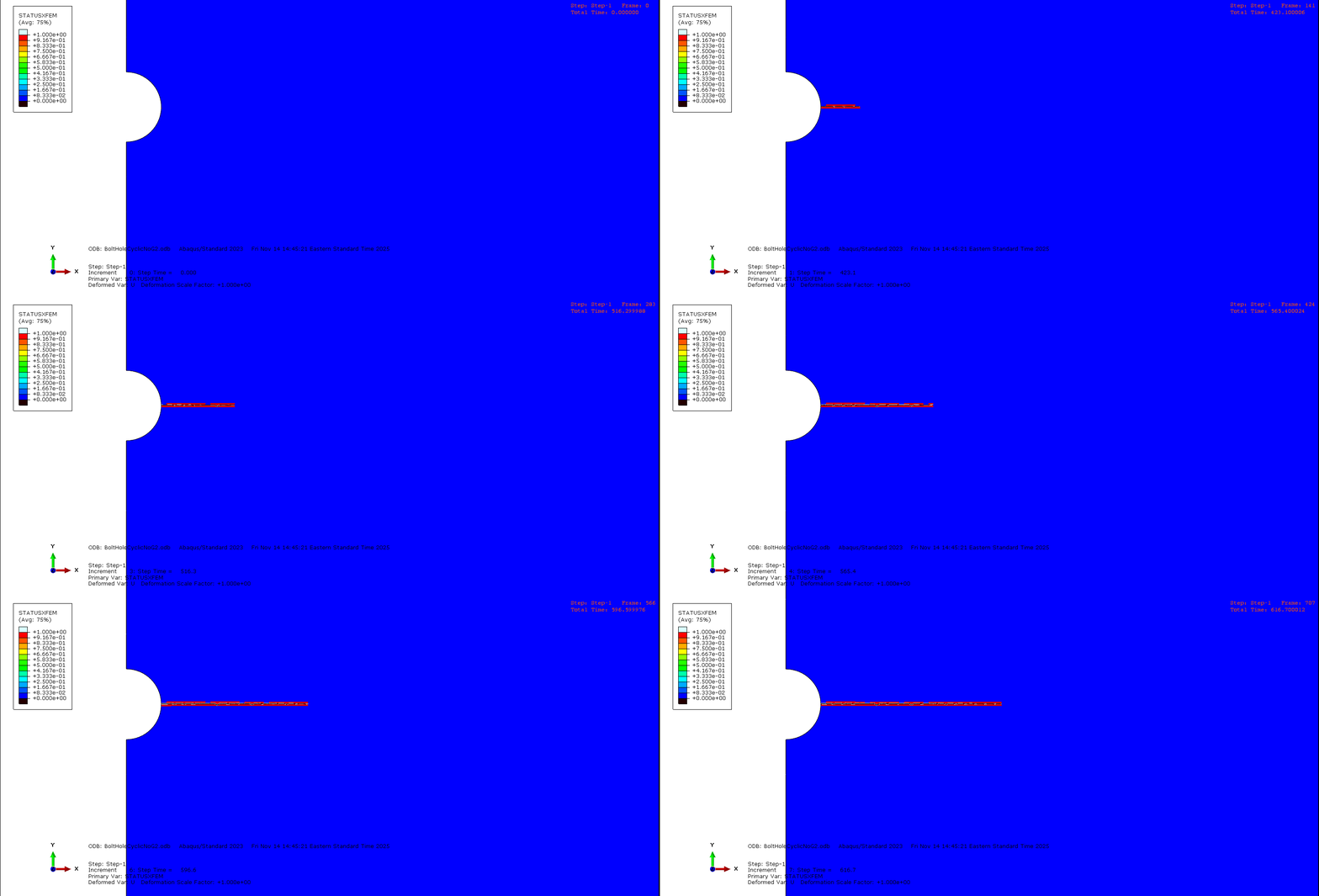
- Simulated a horizontal crack propagating from a 10 mm bolt hole to a 25 mm critical length using a 2D planar shell model and the eXtended Finite Element Method (XFEM).
- Predicted structural failure at approximately 612 cycles (assuming an initial 0.01 mm flaw), closely mirroring the historical failure cycle range and demonstrating the sensitivity of fatigue life to local geometric details.
What I learned
- Theory vs. Software Implementation: I had to mathematically bridge analytical fracture mechanics and Abaqus solver requirements. While the theoretical Paris-Erdogan Law relies on the Stress Intensity Factor range (ΔK), Abaqus calculates crack propagation using the Strain Energy Release Rate (ΔG). Assuming Plane Stress conditions, I used the relationship ΔG = ΔK² / E to convert my material constants (A = 9.6 × 10⁻⁷ and m = 4.0) into the energy-based coefficients (C3 = 0.0051 and C4 = 2.0) required by the software.
- Critical Crack Length Reduction: The analysis reinforced how dangerous geometric stress concentrations are. Hand calculations showed that while the critical crack length for the baseline material was ~19 mm, the stress concentration at the window corner (Kt = 3.34) reduced the critical flaw size to just ~1.7 mm. This drastically smaller threshold explains the catastrophic nature of the historical accidents.
- Analytical Validation: Before running the fatigue simulation, I validated the near-tip Mode-I values extracted from the finite element S22 field. The simulated values clustered around K ≈ 1300 MPa√mm, which successfully correlated with my theoretical calculation of K ≈ 1107 MPa√mm, proving the model had sufficient driving force for sustained propagation.
- Damage-Tolerant Design: This project highlighted why certification evolved toward damage-tolerant substantiation. It proved mathematically that while oval windows are intrinsically more tolerant to pressurization fatigue, modern airworthiness requires geometries that allow cracks to grow slowly enough to be detectable within inspection intervals.