Finite Element Analysis of a Pinned Clevis Assembly using Femap and NX Nastran
Built and solved a mixed-dimensional finite element model of a pinned clevis assembly, combining shell, solid, and beam idealizations with contact and bearing loads to evaluate deformation and principal-stress response.
Media showcase
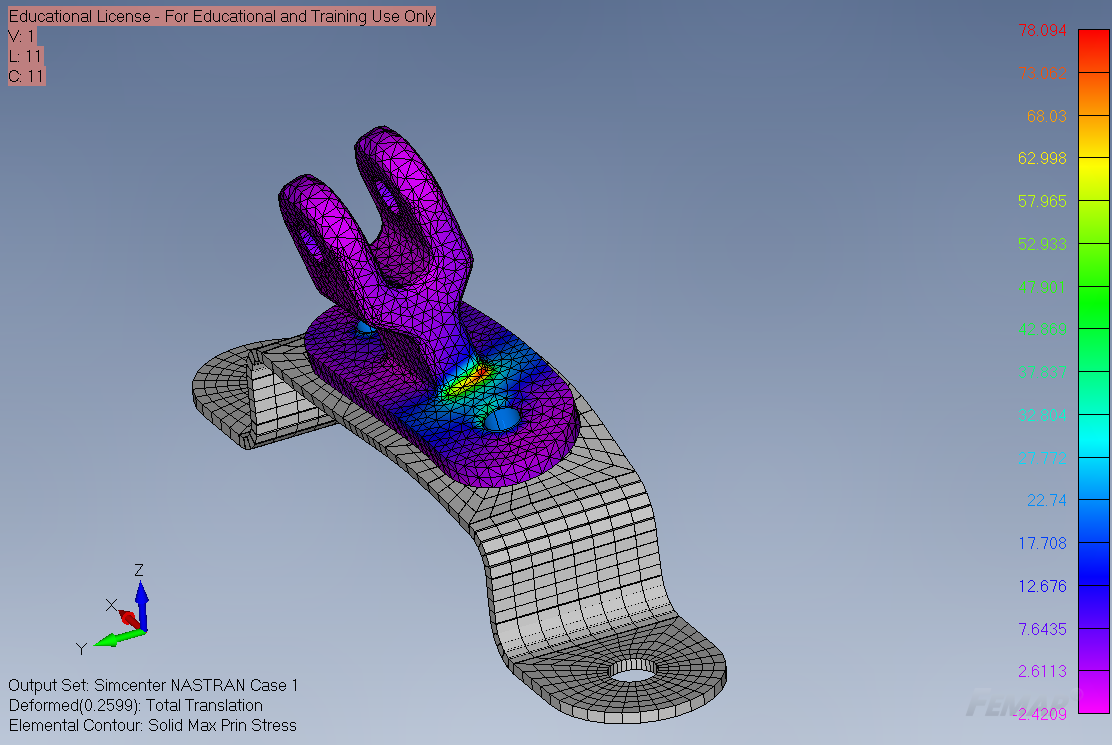
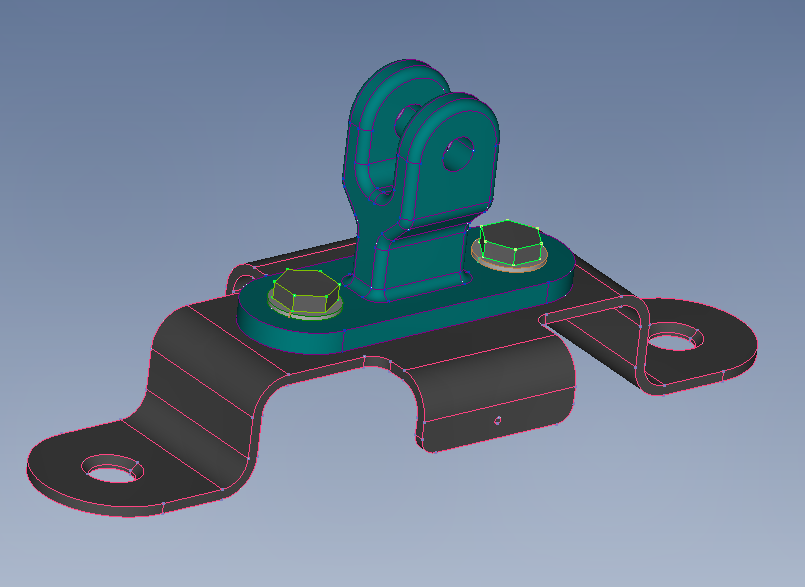
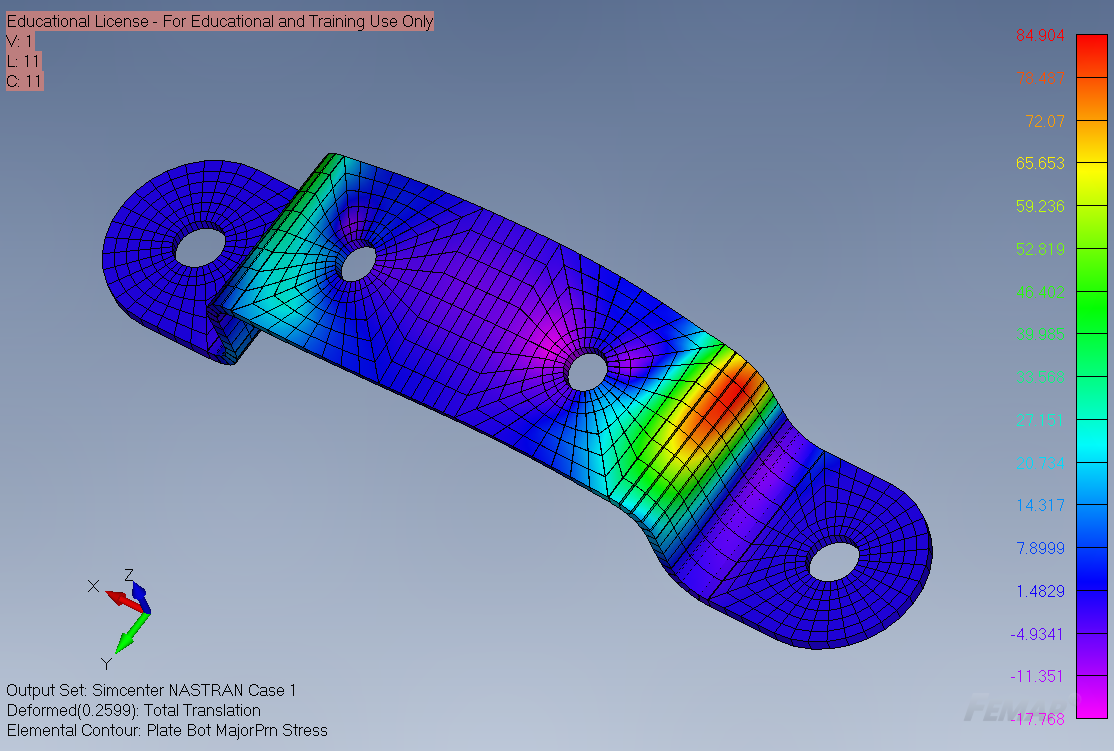
Overview
This guided training project developed a complete finite element workflow for a pinned clevis bracket assembly. The CAD geometry was imported and simplified, thin regions were idealized with mid-surfaces, and local boundary regions were prepared for controlled meshing. Shell elements represented the thin base bracket, tetrahedral solids represented the clevis arm, and beam elements with rigid spiders represented the fasteners. Constraints, directional bearing loads, and surface-to-surface contact were then applied before solving in NX Nastran and reviewing deformation and principal-stress contours in Femap.
Key highlights
- Prepared the imported assembly geometry for analysis by simplifying features, generating mid-surfaces, and partitioning critical regions for mesh control.
- Combined mapped quadrilateral shell elements, tetrahedral solid elements, and one-dimensional beam fasteners in a single efficient model.
- Represented bolted load transfer with beam elements and RBE2 rigid spiders while defining linear surface-to-surface contact between the clevis arm and base bracket.
- Applied structural constraints and directional bearing loads, solved the linear static case with NX Nastran, and post-processed deformation and maximum principal-stress contours.
What I learned
- Geometry Idealization: Prepared CAD geometry for meshing by generating mid-surfaces and isolating boundary regions (washers and pads) to enforce a high-quality, mapped quad mesh around critical stress concentrators.
- Mixed-Dimensional Meshing: Optimized computational efficiency by assigning 2D plate elements with defined thicknesses to the thin-walled base bracket, while utilizing 3D tetrahedral solid elements for the bulkier clevis arm.
- Kinematic Fastener Abstraction: Modeled bolted joints without the overhead of 3D contact by deploying 1D beam elements coupled with rigid spider elements (RBE2s) to distribute transfer loads evenly and avoid artificial stress singularities.
- Linear Contact & Boundary Conditions: Implemented surface-to-surface linear contact regions to accurately simulate physical load transfer between assembly components, and applied directional vector-driven bearing loads to accurately represent clevis pin interaction.